Livaq
Investor Data Room

This investor hub is available to invited recipients. Enter your full name and the email address associated with your invitation.

This material is confidential and intended solely for the authorized recipient.
Demo mode: Supabase is not configured, the gate accepts anyone and analytics log to the console only.
LivaqInvestor Data RoomVerifying…
Sections
01Overview 02Pitch deck 03Strategy 04Technology 05Product pipeline 06Financials
07ClientsSoon
08Cap table & corporate 09Convertible notes
10Press & salesSoon
Confidential · watermarked
01 · Start here

The fastest way to understand Livaq.

Start with the interactive overview, then go as deep as you want. Every document here is downloadable.

02 · Pitch deck

The investor presentation.

The full narrative deck, as presented. Downloadable as PDF.

03 · Strategy

How Livaq wins the category.

By 2030, Livaq is the default electric off-road vehicle provider for North American government fleets. The plan sequences state and provincial fleets first, funds federal and commercial expansion from there, and defends the position with cross-border manufacturing and a modular software platform.

01 · Aspiration

The default electric fleet for government off-road.

By 2030, Livaq is the default electric off-road vehicle provider for North American government fleets, state, provincial, and federal, and the modular propulsion platform of choice for adjacent off-road categories.

What that looks like by Year 5–6
  • 10+ active government contracts across the US, Mexico, and Canada by Year 5.
  • 3+ federal contracts active by 2030.
  • Leading share of the North American off-road market as it electrifies from gas.
  • ~$18M software ARR by Year 6, recurring against the installed base.
How we win it

By becoming the most practical, locally embedded path for governments to electrify off-road mobility. We sell vehicles, we help governments build the operating ecosystem around them, and we deliver per-unit savings of about $7,000 a year that close the procurement decision on its own economics.

02 · The Economics

The deal closes on payback, not policy.

An electric fleet pays for itself out of operating savings. That is the foundation of every sale, and it holds in any regulatory environment.

~$7K
Operating savings per unit, per year, vs gas
~$1.7M
Capital for a 100-unit DNR fleet refresh
~$700K
Operating savings per year on that fleet
<2.5 yrs
Payback from operating savings alone

A 100-unit refresh costs roughly $1.7M in capital and returns about $700K a year in operating savings. The premium over a gas unit is repaid inside the first years, and the agency keeps cutting cost for the life of the fleet. The buyer is not paying a green premium. It is cutting its own budget.

03 · The Customer Cascade

Win the hardest customer first. Compound from there.

Each phase is funded by the one before it and builds the conditions for the next. The qualification is specific, not aspirational.

  • Phase 1 · State & provincial fleets (active). Natural-resource, forestry, parks, and public-safety agencies with 300+ vehicles, 10%+ annual replacement, and a documented procurement budget. North America has about 50 US state DNR-equivalents plus provincial and federal equivalents that fit. The closing argument is the ~$7,000 per-unit annual cost advantage.
  • Phase 2 · Federal procurement. US agencies under the ≥70% USA-content rule: Interior, Forest Service, BLM, and defense applications. Gated by external customs validation of the cross-border architecture. First federal RFP pursued in Year 2.
  • Phase 3 · Private commercial. Operators whose requirements mirror government: ecotourism, security, utilities, agriculture, and rental fleets, riding on the infrastructure government built.
  • Phase 4 · Direct-to-consumer. Recreational riders and clubs, through an online configurator and select dealer partnerships, once service and charging are in place.
04 · Where to Play

North America builds it. The world licenses it.

The footprint is deliberate. Each geography plays a defined role in the architecture and the sequence.

United States · anchor

US-produced differentiating components, US final assembly, and a US-facing government sales motion. This is where federal access is won.

Mexico · integration node

Battery-pack integration establishes the country-of-origin shift under USMCA. State government customers are addressable here too.

Canada · Year 3+

Provincial natural-resource fleets, on the same platform and the same procurement playbook.

International · license only

License the platform to a single global partner. No Livaq-manufactured vehicles outside North America in the five-year plan.

05 · Policy Context

A tailwind, not a strategy.

Thirty-three US states carry active ZEV fleet policies. They open the procurement window. They do not close the deal.

The specific mandates
  • California. 100% ZEV for ATVs by 2030, the only state that names ATVs specifically.
  • Michigan. 100% ZEV light-duty state fleet by 2033, binding under ED 2023-5.
  • Others. Oregon, DC, Connecticut, Illinois, Hawaii, and New York carry parallel light-duty timelines.
Why it is only the clock

A mandate can be delayed, weakened, or repealed. The economics cannot. The decision rests on the per-unit operating cost advantage, and off-road is the one segment no incumbent has electrified. Policy sets when. The savings set whether.

06 · The Three Advantages

Three moats that reinforce each other.

Advantage 01

Government fleet focus

We serve one customer type, government natural-resource and adjacent agencies, better than any generalist. We learn their procurement cycles, service expectations, and politics. Each deployment builds relationships, data, and credibility that generalists cannot easily shortcut.

Advantage 02

Modular platform + software

One purpose-built electric platform carries many vehicle classes, protected by Provisional Patent 63/801,323 with the portfolio expanding through Year 2. The same architecture runs a fleet subscription at $75 per unit per month, ~85% margin, reaching ~$18M ARR by Year 6 and on the order of $178M of enterprise value at a 10× multiple.

Advantage 03

Cross-border manufacturing

US-made differentiating components, Mexican battery integration, US final assembly. The vehicle clears the ≥70% USA-content threshold under USMCA, engineered into the bill of materials. The architecture supports access, not just the final assembly location.

Why each competitor fails to occupy this position
Polaris & BRP
ICE manufacturing legacy. Electric transitions are compromised and slow, and the customer focus is generalist. They cannot match a purpose-built, hyper-specialized electric platform.
Chinese OEMs
Competitive on sticker price, but no US-content qualification, no local service, and no government-channel credibility. Closed out of federal procurement by supply-chain origin.
EV ORV startups
Purpose-built electric, but built on white-labeled chassis. No platform extension across classes, no manufacturing leverage, no customer specialization in government.
07 · Capabilities & Boundaries

What we own. What we deliberately do not.

Five capabilities we own
  • Modular EV chassis & drivetrain. Purpose-built electric architecture, in-house, with a provisional patent pending.
  • Battery, software, vertical integration. Smart battery and BMS as the country-of-origin lever; the software team owns OTA, the driverless roadmap, and the subscription product.
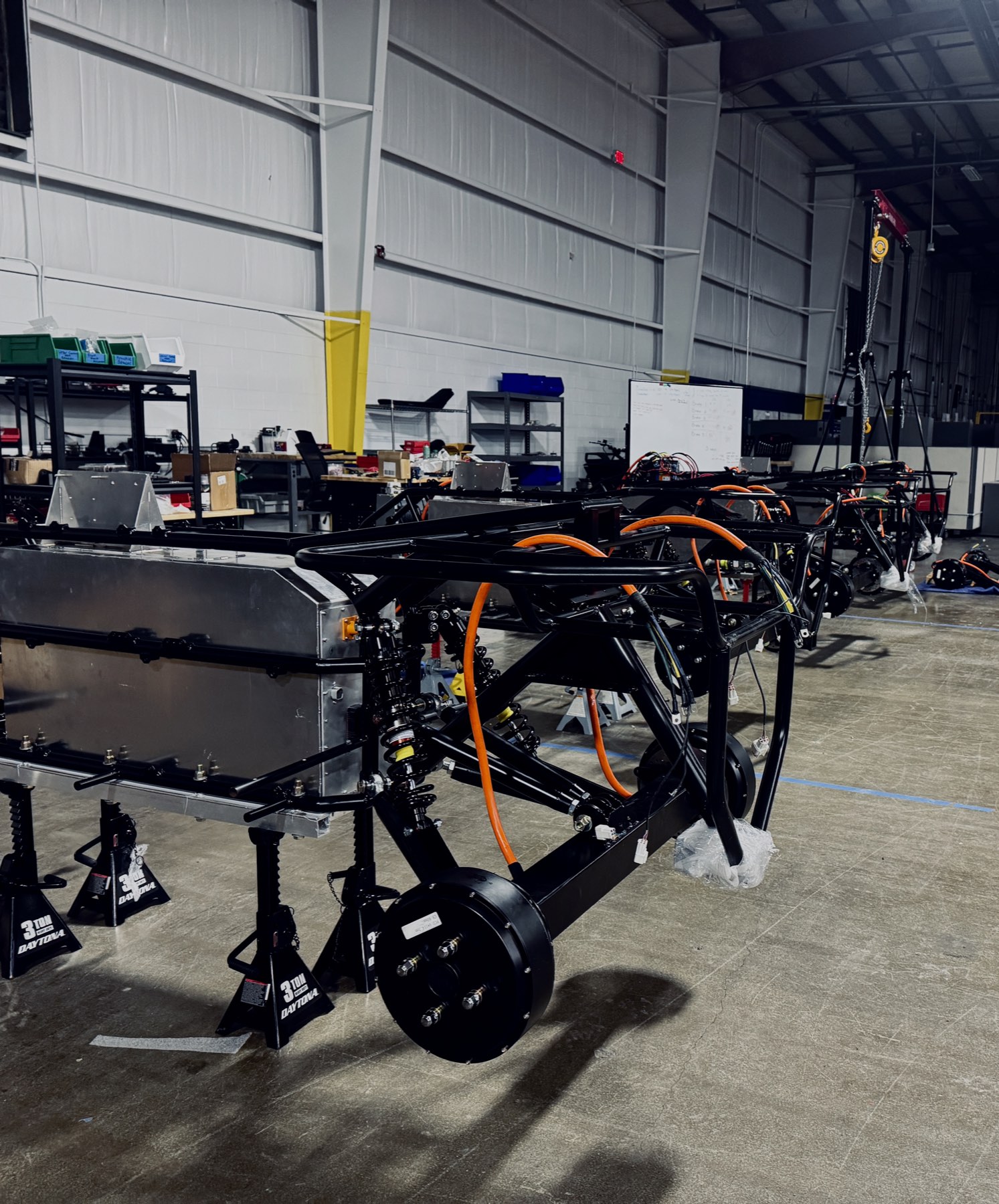
  • Automated manufacturing partners. Frame, assembly, and battery integration through partners qualified on automated yield and throughput, not labor.
  • Government sales motion. RFP-driven, multi-year, with references that compound across agencies.
  • Productized platform for licensing. The propulsion stack as a licensable product by Year 4.
What we will not build
  • Charging infrastructure. Customer or partner responsibility.
  • Cell manufacturing (Y1–Y3). Cells are bought; a US-based JV is a Year 4+ option.
  • Motors. Commodity. We integrate, we do not manufacture.
  • Dealer network. Government direct, D2C online. No retail expansion.
  • Captive finance. Equipment-lease firms and standard procurement terms in the plan.
08 · Risk

Designed to absorb the obvious failures.

  • Partner concentration. Multiple qualified partners per critical function. Any single partner is swappable without breaking the architecture.
  • USMCA renegotiation. The architecture is designed for stricter content rules, and US-only assembly capability is preserved as a fallback.
  • Execution under lean staffing. Partners must run automated production systems, which reduces failure risk and raises throughput.
  • Phased funding of growth. Phase 1 government revenue funds Phase 2 commercial, which funds Phase 3 direct-to-consumer.
  • Driverless regulation. Constrained-environment scope only, a far lower regulatory burden than public-road autonomy.
  • Technology obsolescence. A two-year refresh cycle for battery and propulsion components avoids lock-in to one generation, pushed to the deployed fleet over the air.
04 · Technology

The stack is the moat.

Five systems make an off-road EV. Livaq builds the ones that compound — controller, BMS, and the connected software layer. Use the allocator below to see how funding choices shift the roadmap and the financial model.

02 · Control Stack Roadmap

The platform behind electric off-highway.

Livaq is building the integrated control stack, the software, controller, and battery management that every electric off-road vehicle runs on. Own the stack, and every vehicle class becomes a configuration of it. That is how a single product becomes a category.

In the field today

A proven vehicle, deployed and earning revenue. Livaq's own software running it. A modular, patent-pending architecture. The controller is third-party for now, with our own in development.

Track
Y1
Y2
Y3
Y4
Y5
Y6
Control stack
Controller, BMS, OTA in build

Controller & OTA live · BMS to production
Mature integrated stack
Software & OS
Own software live today
Driverless: sim → pilot
Driverless productized · Licensable OS
Recurring software scales
Provisional patent 63/801,323 (pending) establishes priority on the propulsion architecture; the raise funds the BMS, controller, and OTA IP on top of it.
03 · The Five Systems

One architecture. Five systems to own.

An off-road EV comes down to five systems. Livaq's plan is not to build all five from scratch — it's to buy the commodity systems and own the three that compound: controller, BMS, and software.

Motor & powertrain
Off-the-shelf motor, integrated and tuned for off-road duty cycles. Duty-cycle validation across terrain and load profiles is planned for Q4 2026. Not a moat on its own, but the integration work is what makes the EQUAD's range and torque curve feel purpose-built rather than adapted from a road vehicle.
Motor controller
Third-party today, in-house by design. The controller is the real-time decision layer between rider input and the motor, and owning it unlocks drive-mode tuning, efficiency gains, and cost-down that a vendor part can't. Target: in-house controller ships Q3 2027.
Battery & BMS
The BMS is both a safety system and a data system: it manages cell health and thermal behavior, and it is the sensor layer Livaq OS reads from for Protect (failure prediction) and fleet reporting. Proprietary BMS targeted for production Q1 2027, alongside Mexico-based pack integration that shifts country-of-origin under USMCA.
VCU & software
The vehicle control unit and Livaq OS turn a mechanical vehicle into a connected one: OTA updates, telemetry, and the constrained-environment driverless roadmap all run through this layer. It's the system with the clearest recurring-revenue path, at $75/unit/month once live.
Chassis
The modular frame and body architecture is what lets EQUAD 4X4, KEI Truck, SVS, and future classes ship as configurations of one platform instead of separate engineering programs. Tooling and validation work scale with each new vehicle class added to the line.
What stays sourced

Motors and battery cells are commodity inputs — Livaq integrates them, not manufactures them. Frame fabrication, sub-assembly, and battery-pack integration run through qualified manufacturing partners, chosen for automated yield and throughput rather than labor cost.

What we build in-house

The motor controller, the BMS, and the VCU/software stack — the three systems that carry the country-of-origin qualification, the safety-critical control logic, and the recurring software revenue. These are the systems this round is funding.

04 · Capital plan allocator
$6.1M
of $6.1M
Moat systems controllers + BMS + software
100%
Sets cost-down and recurring-revenue timing in the model.
Build systems mules + production tooling
100%
Sets deployment timing slip in the model.
Powertrain, VCU & controllers$0.6M
In-house controller ships · Q3 2027
BMS & battery development$1.4M
Proprietary BMS to production · Q1 2027
Driverless & software$0.4M
OTA + recurring revenue live · Q2 2027
Development mules & integration$2.5M
Second vehicle class on platform · Q4 2027
Production tooling$1.3M
Welding, CNC and fixtures · Y1-Y3
This is the $6.09M capital plan from the financial model, split by system. It carries into Financials → Scenario model: CapEx, the margin ramp and the timing dial all open pre-set to match it.
05 · Product pipeline

One platform. Many vehicles.

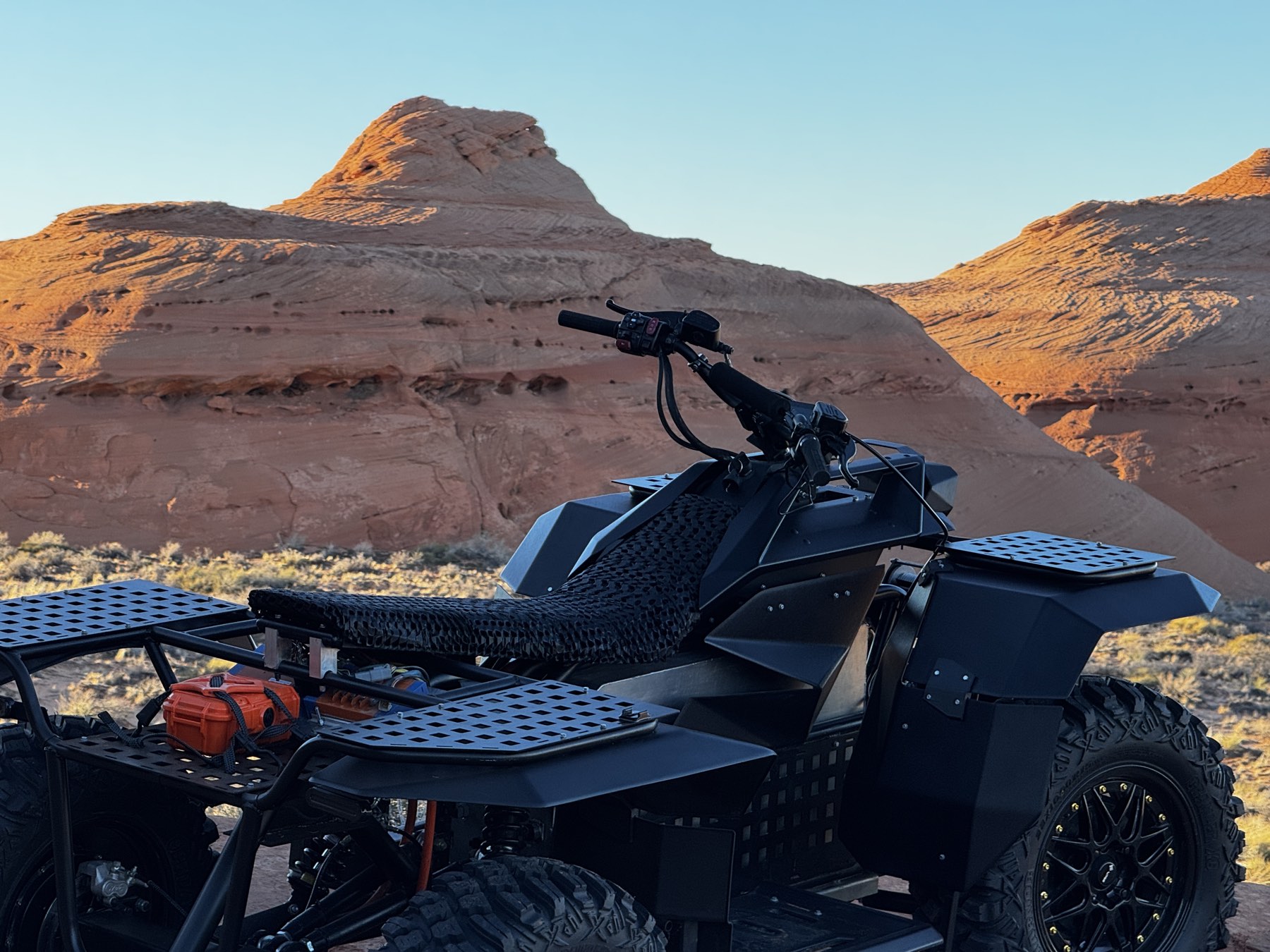
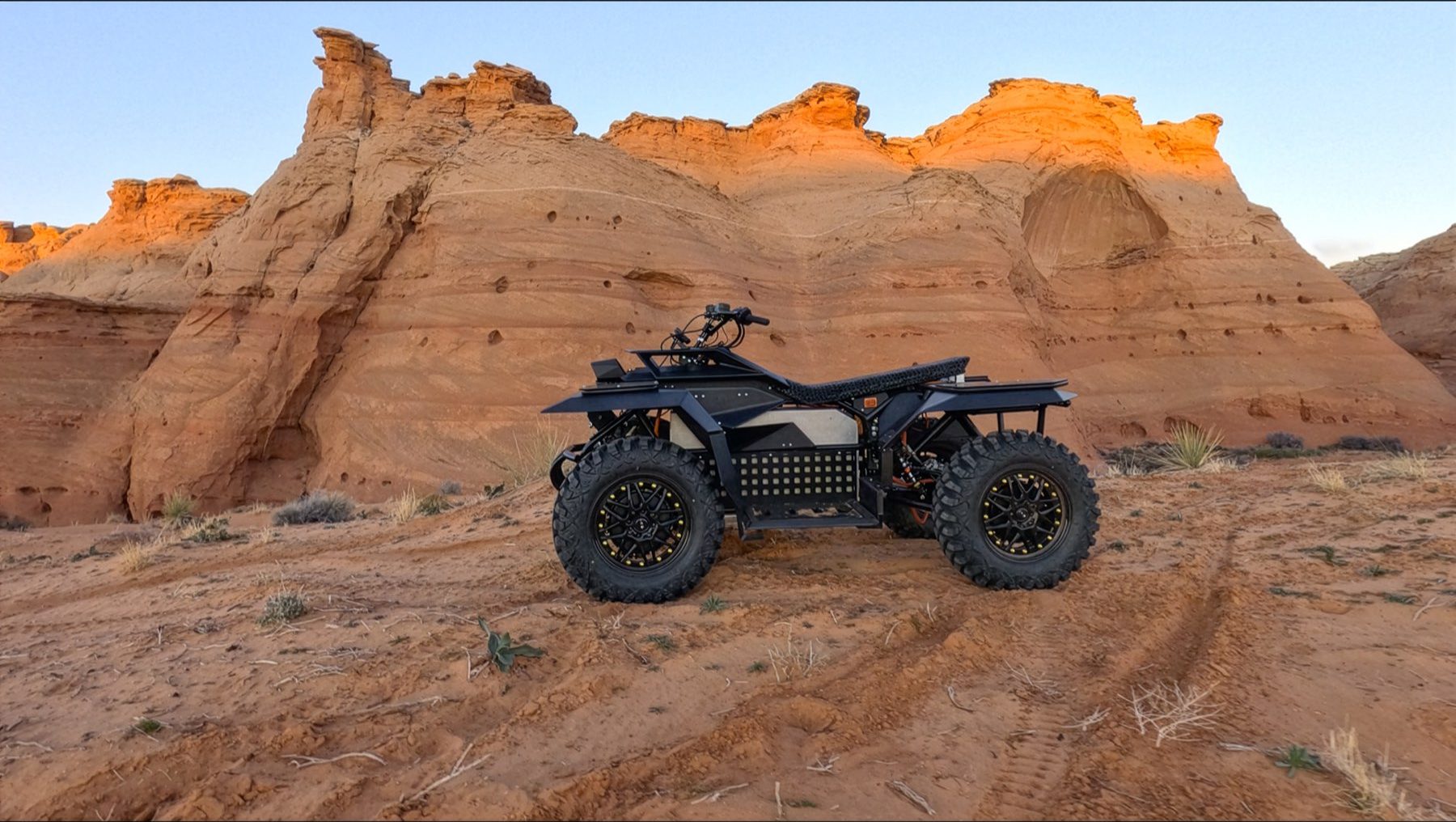
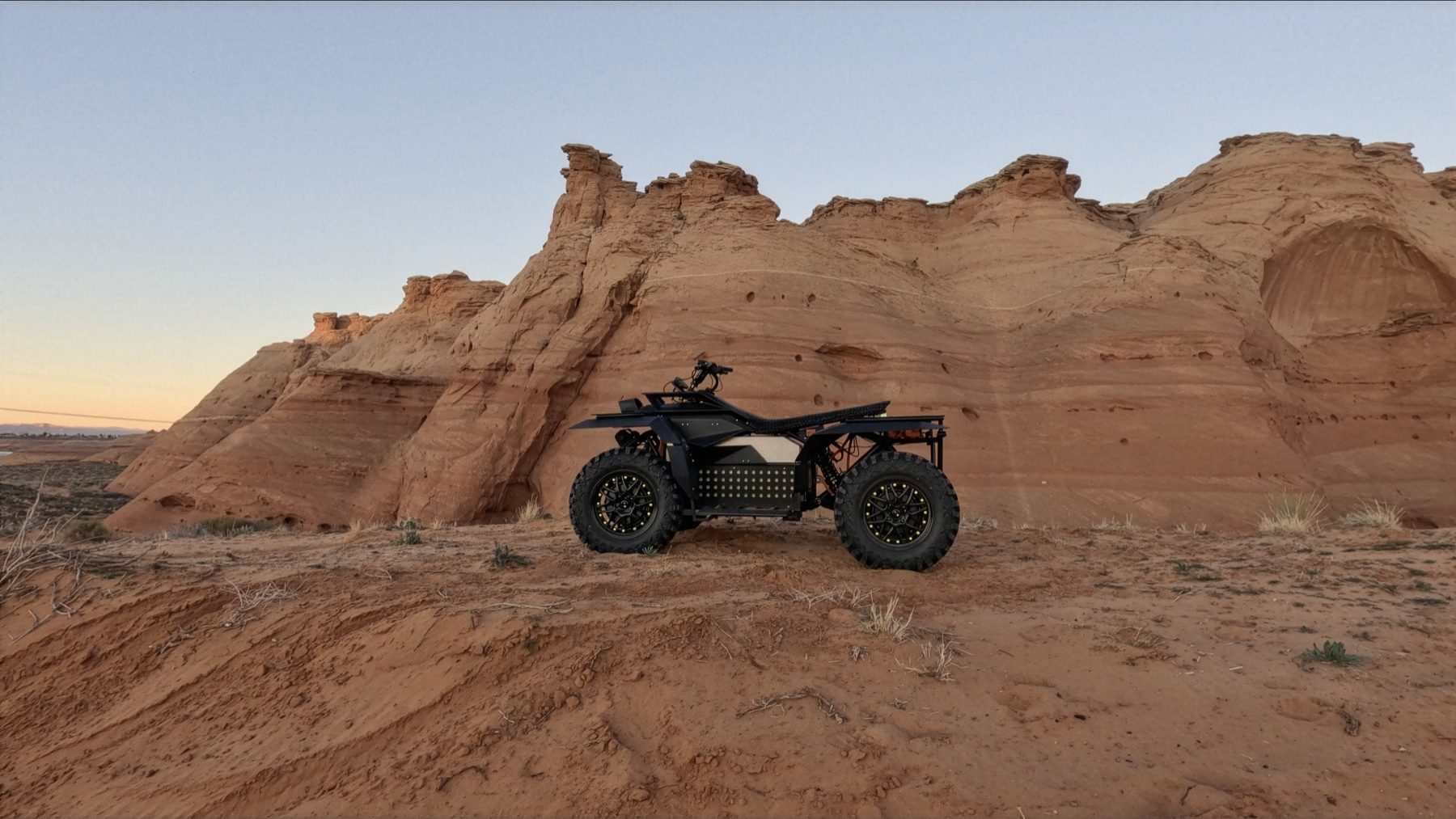
The EQUAD is the proof: a proven, deployed electric ATV built on a modular platform that configures into an expanding line of off-road vehicle classes.

02 · Platform & Proof

The platform is the product. The EQUAD is the proof.

Livaq's long-term value lives in the platform, not any single model. The same propulsion stack can scale across multiple vehicle classes, so each new product is a configuration of a proven architecture, not a new engineering program from scratch. The platform is patent-pending and vehicle-agnostic: the LIVAQ platform, driven by its flagship product, the EQUAD.

LIVAQ OS: the recurring layer

Every gas fleet runs blind; a Livaq fleet runs connected and improves over time. The OS is Livaq's own software, in the vehicle today. Livaq is building the proprietary control stack beneath it, the in-house BMS and motor controller, and connected telemetry that turns each vehicle into a recurring-revenue asset: Protect (battery-health monitoring and failure prediction), Perform (configurable drive modes and efficiency gains), and Operate (utilization, location, and required compliance reporting). At scale, Livaq OS becomes the recurring software layer on top of every connected vehicle.

The proof in the field: the EQUAD
  • 120 mi tested range (4x4), 67 mph tested, built for sustained all-day field use.
  • Safer by design. Battery placement lowers the center of gravity and the chassis geometry keeps the vehicle planted on slopes and at speed, reducing the rollover risk behind most serious ATV incidents.
  • Fully waterproof (IP67) and customer-serviceable in the field through modular design.
The federal lever, engineered in

The architecture is engineered around country-of-origin. The differentiating components, the BMS, motor controller, and VCU, are US-made; the battery pack is integrated in Mexico, which shifts country-of-origin under USMCA; US final assembly meets the ≥70% USA-content federal threshold by value, supported by a US certificate of origin. The architecture qualifies the vehicle, not the geography.

The savings case, at agency scale

Livaq cuts agency operating cost by up to $7,000 per unit each year. For a 400-vehicle fleet that is about $2.8M saved annually, roughly $14M across a five-year fleet life. The price premium over a gas unit is repaid inside the first year, from operating savings alone.

03 · The line

Configurations off one stack.

EQUAD · Y1 · shipping
The core electric ATV. Deployed with the State of Puebla and in pilot with Michigan DNR.
EQUAD 4X4 · Y1 · shipping
Four-wheel-drive variant for steep grade and heavier field loads.
Driverless · Y2
Constrained-environment driverless operation: perimeter patrol, return-to-base, follow-me, on the same platform.
KEI Truck · Y3
Compact utility truck configuration for expanded fleet and cargo use cases.
SVS · Y4
Side-by-side utility vehicle configuration, same propulsion and control stack.
Limited Edition · Y6
Premium/performance configuration closing out the six-year product line.
EQUAD at a glance
170 mi
Range, all-day field use
87 mph
Top speed
1,200 lb
Payload capacity
IP67
Sealed, field-serviceable
04 · Roadmap

One platform, rolling out over six years.

Each new vehicle class is a configuration of the same propulsion architecture, expanding the buyer set as the control stack matures. See the control stack itself in the Technology section.

Track
Y1
Y2
Y3
Y4
Y5
Y6
Vehicles
EQUAD
EQUAD 4X4
Driverless
KEI Truck
SVS
Limited Ed.
Markets
State & provincial fleets
+ Federal
+ Commercial
+ Licensing & adjacencies
Aligned to the Livaq financial model: units scale 50 → 8,050 per year as the product line and buyer set expand across the platform.
05 · Pricing

One platform. Many vehicles. Recurring revenue.

OfferingDetailPrice
EQUAD · base4x2, fenders, standard seat, Level 1 charger$17,500
EQUAD · full-spec4x4, carbon body, tow, performance, 3D seat, Level 2$28,500
Add-onsSkid plate / winch, sold separately$1,500 / $2,500
Fleet softwareTelematics, OTA, fleet management · live ~mid-Y2.5$75 / unit / mo
Licensing · Y4+Productized propulsion platform, single global partnerRoyalty + license

Vehicle lines on the shared modular platform: EQUAD 4X4 (Y1), Driverless (Y2), KEI Truck (Y3), SVS (Y4), Limited Edition (Y6). The driverless line targets constrained-environment use such as perimeter patrol, return-to-base, and follow-me, on the same platform.

Documents in this section
PDFEQUAD spec sheetPowertrain, range, payload, and gradeability.3 pages
APPConfiguratorBuild a unit and see price and lead time.coming soon
06 · Financials

Margins that compound.

The operating plan, the margin ramp, and a live funding stress-test you can run yourself. Gross margin turns positive in Year 2 and climbs toward 35% as volume builds; revenue scales from $1.2M to $377.8M across the plan.

Livaq Margin Ramp & Funding Stress

Opening state = Plan baseline · fully funded · ~$255.5M 6-yr EBITDA

Drag the dots to shape the gross-margin ramp. The x axis is time, the y axis is gross margin, and each dot is one year. Pull a year up or down and the model recomputes EBITDA, the cash trough, and the bridge live. Then stress it with the operational dials below. The opening state is the Plan baseline, the model fully funded with every year on plan, and every move you make reads against it.

REVENUE & EBITDA BY YEAR ($M)

Revenue EBITDA (positive) EBITDA (negative)
CASH
RUNWAY
months until cash runs out
FUNDED TO
BREAK-EVEN
Fully funded
TOTAL TEAM
SIZE
206 / 206
people at peak (Y6)
BLENDED
BOM / UNIT
$28k
across the plan
6-YR CUMULATIVE
EBITDA
$255M
vs $255.5M at plan

MARGIN RAMP — DRAG BY YEAR

Drag any dot vertically to set that year's gross margin at plan volume. Range -15% to +40%.

Blended BOM $28k/unit At-scale BOM $30.5k/unit Margin turns positive Y2

OPERATIONS

SALES VOLUME100% of plan
Share of the planned unit volume Livaq actually sells.
TIMING SLIP0months
Delay before deployments ramp. Shifts early revenue later.
MAIN TEAM100% of plan
Share of the full-plan salaried team carried. The floor, 15%, holds the main team: core leadership only.
ASSEMBLY CREW STAFFED100% of need
ASSEMBLY EXECUTION RISK
LOW
210 build-days at Y3 peak.
FUNDING RAISED$17.5M
CAPEX$6.1M
Plan CapEx is $6.1M total. Scales the cash drawn for tooling and capacity.

THE NUMBERS

YEARUNITSREVENUEMARGINCOGS/UNITEBITDACASH BAL.

EQUAD · at a glance
170 mi
Range, all-day field use
87 mph
Top speed
IP67
Waterproof, field-serviceable

Redefining
off-highway mobility.

Helping government agencies cut millions from their operating budget, run safer fleets, and deploy vehicles that improve over time.
David Medina Álvarez · Founder & CEO · Detroit, Michigan
livaq@livaq.co · +1 313 410 4350 · livaq.co
Filed & deployed
Provisional patent 63/801,323
State of Puebla · live
Michigan DNR · pilot
Policy tailwind
33
US states with active ZEV fleet mandates
01 · The Problem

A problem agencies need to solve.

Their fleets are expensive to operate and dangerous to ride. An agency spends roughly $8,000 per unit a year on gas and service; across a 400-vehicle fleet, that is about $3.2M every year in fuel and service alone, before the cost of acquiring the vehicles.

An electric fleet's cost per mile is stable and largely insulated. Safety compounds the problem: conventional ATVs are unstable at sharp slopes and high speeds, leaving agencies with real injury and liability exposure.

~$2.8M
Saved per agency fleet, every year
Converting a 400-vehicle fleet saves up to $7,000 per unit each year. The buyer is not paying a green premium; it is cutting its own operating budget. Policy reinforces the shift, with 33 states carrying deadline-driven ZEV fleet mandates, but the demand is financial first.
Annual cost / unit
Gas$8.0k
Electric~$1.0k
≈$7,000 saved per unit, per year
02 · The Market

A $25B market electrifying from gas.

$25.3B
Off-road vehicle market, 2025
5 segments
ATV · SVS · Kei · Driverless · Limited Edition
~$7K
Annual savings per unit vs. gas
≥70%
U.S. content threshold for federal access
Source: Mordor Intelligence

The off-road vehicle market is not a small electric niche. It is a ~$25B gas-dominated category now entering the same transition that reshaped passenger vehicles: electrification, lower operating cost, quieter operation, and fleet-level emissions pressure.

Livaq is built to replace gas vehicles across the full off-road market, starting with government fleets, where procurement, infrastructure, and service can scale adoption faster than consumer demand alone.

The beachhead: government fleets

North American natural-resource agencies operate large off-road fleets across state, federal, and provincial levels. Many agencies manage hundreds of vehicles and replace a portion of their fleet every year.

This creates a concentrated entry point for Livaq: fewer buyers, larger orders, clearer use cases, and a repeatable replacement cycle.

~3,000 units / yr
Estimated replacement demand across North American government fleets
The federal layer: a built-in barrier

Federal and government procurement increasingly rewards vehicles with high U.S. content and domestic supply-chain alignment.

That creates a structural advantage for Livaq. Low-cost, Asia-heavy supply chains may compete on price, but they face friction in government procurement. Livaq is being engineered from the bill of materials up to clear that threshold.

03 · Why Livaq

Not a vehicle. A category platform.

Livaq enters the market through vehicle sales, but the company compounds through the assets built around each deployment: government procurement access, fleet relationships, modular vehicle architecture, connected software, and federal-ready manufacturing.

The result is not a one-product business. It is a defensible platform for electrifying off-road fleets.

Moat 01

Government fleet focus

A specialized sales and deployment channel for natural-resource and public-sector fleets.

Moat 02

Modular platform + software

A propulsion and vehicle architecture that can scale across ATV, SVS, utility, driverless, and performance applications.

Moat 03

Cross-border manufacturing

A manufacturing strategy designed to meet domestic-content expectations and create a procurement barrier against import-heavy competitors.

04 · Traction & The Raise

Deployed and expanding. Raising to build the category position.

Traction: deployed & expanding

Concept to production in under three years. Units are in active service with the State of Puebla, a paying government customer, with a 50-unit follow-on order in negotiation and a 200-unit LOI (~$10M) for 2027. Michigan DNR has an active pilot in the field, backed by a letter of intent, with fleet procurement the next step. Real vehicles, real operating data, real forward demand.

Deploy

Government pipeline

Close the Puebla follow-on and 2027 LOI, deliver the DNR commitment, and package documented per-unit savings into the procurement motion.

Qualify

Federal procurement

External customs validation of ≥70% USA content and first federal RFP pursuit, a market where import-heavy rivals face procurement friction.

Connect

Platform & software

Build the always-connected telemetry and OTA capability that activates the recurring software layer from Year 3: battery health, fleet monitoring, configurable performance.

The raise
Capital converts a proven product and a paying customer into a durable category position.

Livaq is raising a round sized to reach break-even, roughly 24 months of runway, to build the proprietary control stack and scale government-fleet deployments. The capital funds three moves: deploy the government pipeline, qualify for federal procurement, and build the connected-software layer. The milestones above define the use of funds.

Runway to break-even
TodayDeployQualifyConnectBreak-even · ~24 mo
07 · Clients

Who is buying.

Fleet customers, pilots and the pipeline behind them.

Downloads & tools
Documents in this section